Have you ever read a classic novel and questioned your ability to speak English?
You’re not going crazy. English has changed so much over the centuries since Shakespeare and even more before that!
Well, there’s actually a great linguistic explanation behind this!
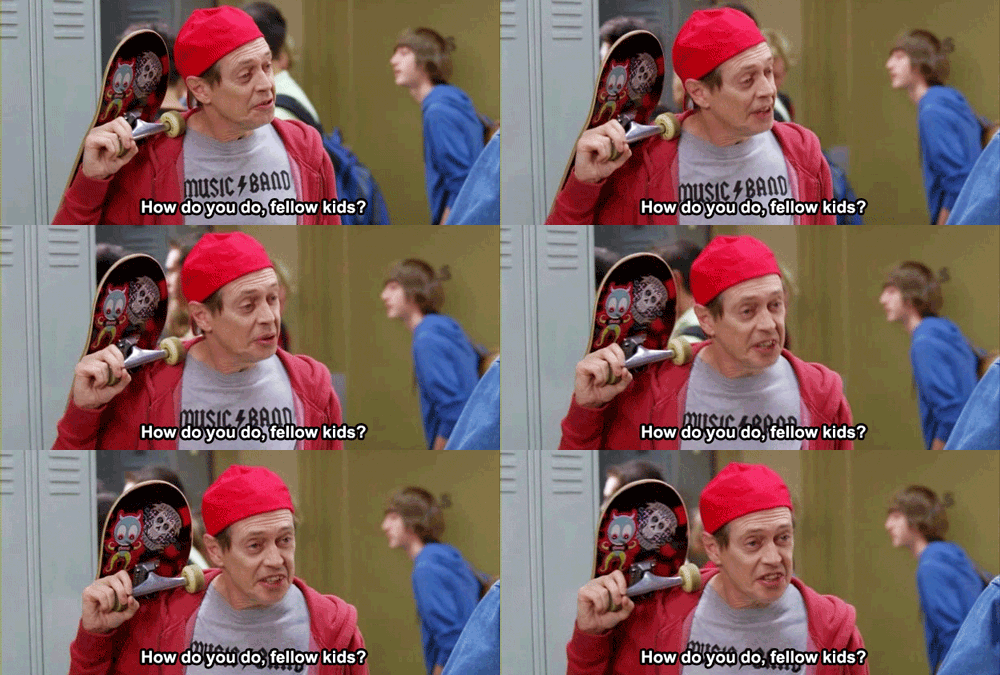
Firstly, it’s important to understand that you don’t talk exactly like how your parents do, and even more so your grandparents. In fact, you’re likely to be repulsed if they try to start talking more like you; it’ll feel kind of like the image below.
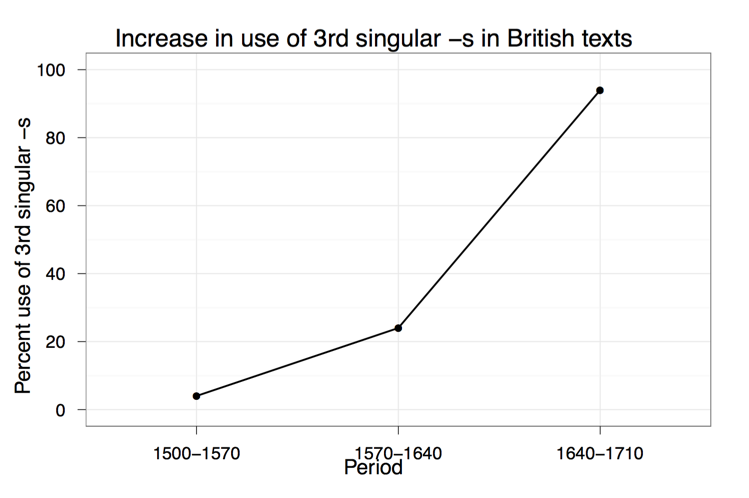
This is a completely natural process, known as language change! Younger people start using new terminology, or even change the grammar, and it slowly catches on as generations move on. A clear example of this is the ending “-eth.” You’re probably familiar with it, from popular phrases like “the cup runneth over.” It actually used to be what “-s” is to us now, but across generations, people have shifted away from it.
Now, as a grammatical change, this is quite an extreme case. Usually, it is much easier to create new words, or new definitions for existing words. These innovations fall under what is popularly labeled as “slang.” Many of these innovative words don’t cement themselves in our daily language, but some (like “ghosting“) seem like they’ll stay in our language for a while.
It is important to note that changing between new and old versions is quite a long process. Refer to the graph above; the process of language change tends to follow an s-shape curve, analogous to infectious diseases. As a new way of saying something spreads, the amount of people exposed to it also increases, which leads to exponential growth until nearly everyone is saying it.
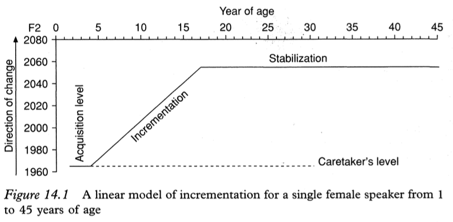
But this is still an oversimplification. For linguistic adoption, people tend only pick up these new ways of speech when they are young, stabilizing with what they say generally around the point of entering adulthood. This is a promising piece of evidence for why you don’t talk like your parents.
Of course, this is not the only factor. Remember how I mentioned it would be awkward if your parents picked up the slang you say? This is due to another part we previously overlooked: language’s role in identity.
Acknowledgements:
The interactive portions of this exhibit are based off the Bible, a text with a deep history of English translation. “Old English” phrases are sourced from Euangelium Secundum Mattheum: The Gospel of Saint Matthew in West-Saxon, which includes text produced c.450-c.1100. “Middle English” phrases are sourced from the Wycliffe Bible, produced in the mid-to-late 14th century. “Modern English” phrases are adapted variants of modern translations, tailored to make the game more seamless and enjoyable.
This specific exhibit was made for the course, Language and Society, at New York University’s department of Linguistics. This section was taught by Laurel MacKenzie for Spring 2026. If you’re a student at NYU and have the opportunity to take this course, please do!!! The main source for this article are the class’s lecture slides for “09 – Language & time: Language change,” which is unfortunately not currently available for public viewing.
